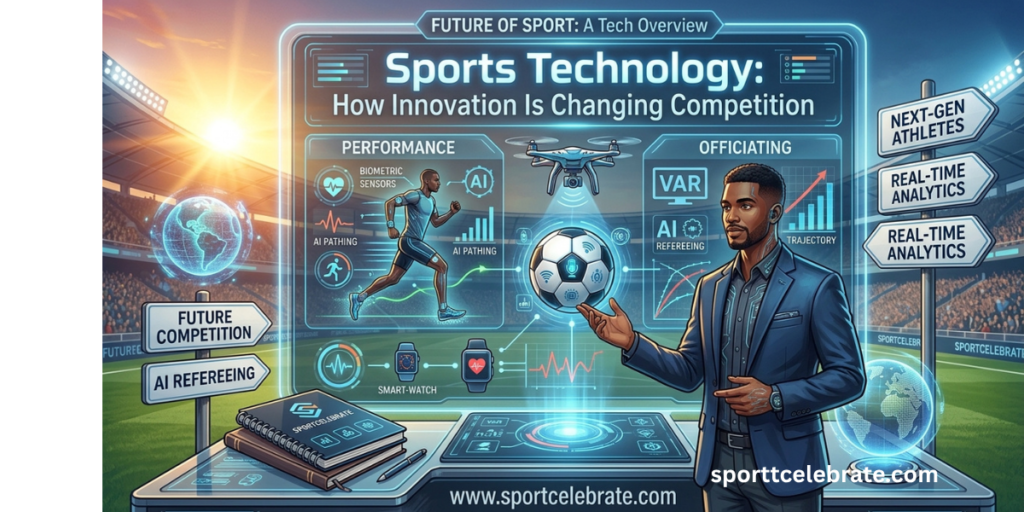
Sports technology has changed the way athletes train, compete, recover, and even understand their own performance. What once depended heavily on personal observation and basic statistics can now involve sensors, video analysis, artificial intelligence, wearable devices, advanced timing systems, and real-time data.
For fans, these changes can be easy to notice. A controversial decision may be reviewed on video within seconds. A runner’s time can be measured with extreme precision.
A football team can analyze player movement after a match. A cyclist can monitor power output throughout an entire race. The result is a sporting world where technology and competition are increasingly connected.
What Is Sports Technology?
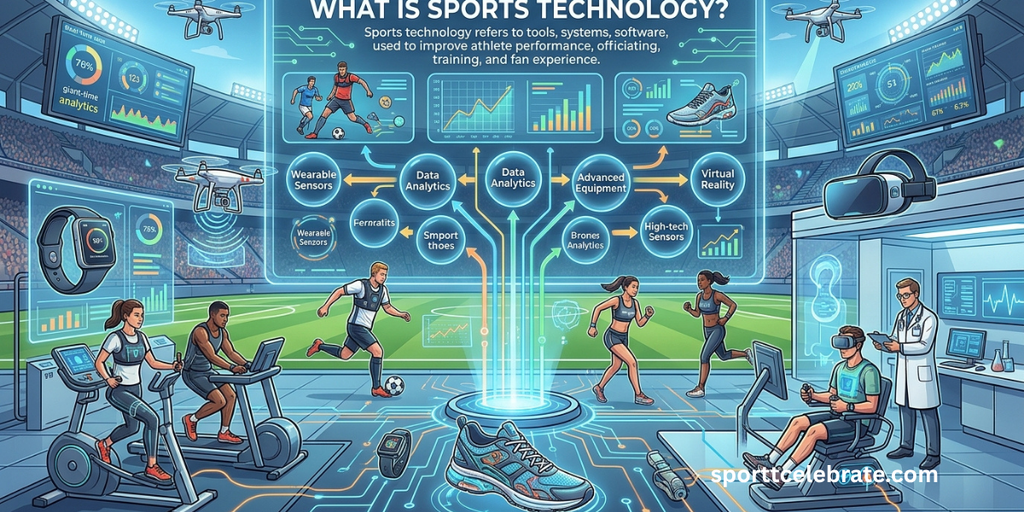
Sports technology refers to tools, systems, software, and equipment designed to improve sporting performance, competition, officiating, training, safety, or the fan experience.
It can be as simple as an electronic scoreboard or as advanced as an artificial intelligence system analyzing thousands of pieces of performance data.
Modern examples include:
- Wearable fitness trackers
- GPS performance systems
- Video replay
- Electronic timing
- Hawk-Eye-style tracking
- Artificial intelligence
- Biomechanical analysis
- Smart equipment
- Virtual reality training
- Digital performance platforms
These technologies don’t all serve the same purpose. Some help athletes perform better, while others help officials make decisions. Others are designed mainly to make sports more engaging for fans.
must read about: IndyCar Grand Prix Guide: Races, Drivers and Format
How Technology Has Changed Athletic Training
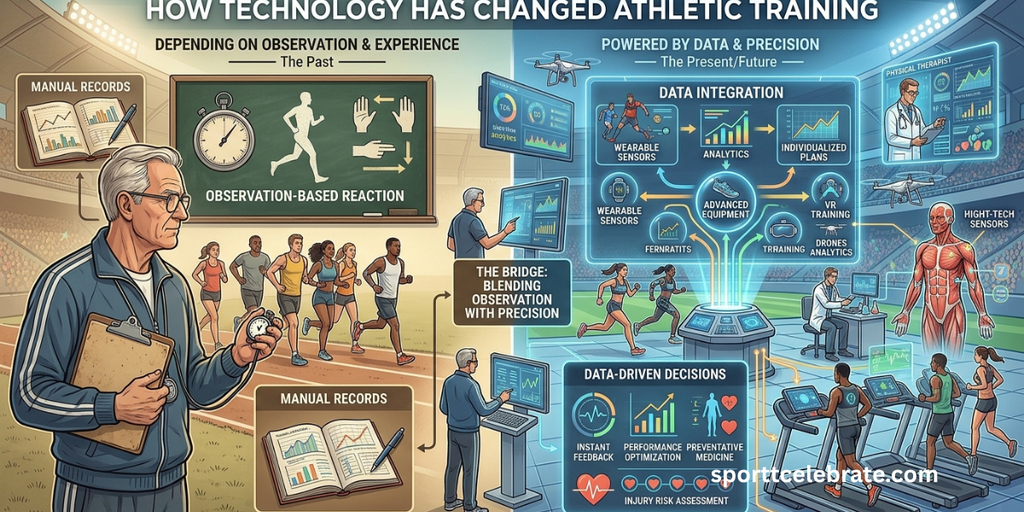
Training used to depend heavily on observation and experience. A coach could watch an athlete run, lift weights, practice a skill, or complete a workout and then provide feedback.
That approach remains important, but modern sports performance technology provides additional information.
Athletes can now track metrics such as speed, acceleration, heart rate, workload, movement patterns, and recovery indicators.
Instead of simply saying that a player looks tired, a coaching staff can examine measurable information and compare it with previous sessions. This creates a more detailed picture of performance.
Wearable Technology
Wearable devices are among the most visible examples of innovation in sport. Athletes can wear specialized sensors that collect information during training or competition.
Depending on the sport and device, this can include:
- Distance covered
- Speed
- Acceleration
- Heart rate
- Movement patterns
- Training load
- Position
- Jump height
- Power output
The value isn’t necessarily in collecting huge amounts of information. The real benefit comes from understanding which information can improve decisions.
GPS and Player Tracking
GPS tracking has become particularly useful in team sports. A football or soccer player can cover several miles during a match, but total distance doesn’t tell the whole story.
A player may spend much of the game walking or jogging but then make several high-speed sprints. Tracking systems can help coaches understand these differences.
They can examine acceleration, deceleration, sprint frequency, positioning, and overall workload. This can influence training plans and substitutions.
For example, a coaching staff may identify that a player has experienced an unusually high workload over several matches and adjust training accordingly.
Data Analytics and Competition
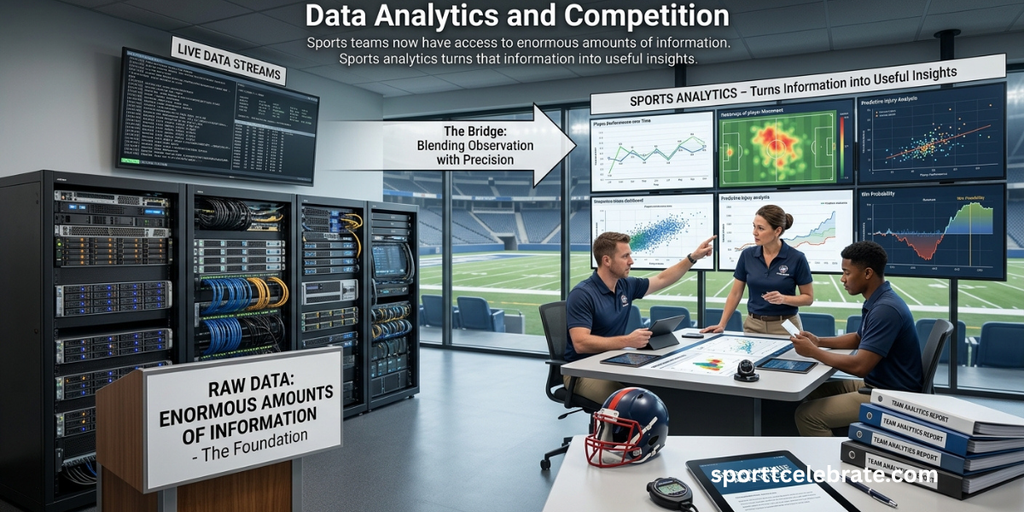
Sports teams now have access to enormous amounts of information. Sports analytics turns that information into useful insights.
A baseball organization can analyze pitch selection and launch angles. A basketball team can examine shot locations and defensive positioning.
A football team can study passing patterns and pressing intensity. A racing team can analyze tire performance, fuel consumption, lap times, and aerodynamic behavior.
The goal isn’t simply to collect statistics. It’s to use information to make better decisions.
Artificial Intelligence in Sports
Artificial intelligence in sports is becoming increasingly important. AI systems can process large amounts of information faster than a human team could manually analyze it.
Depending on the application, AI can help identify patterns in player movement, analyze video, support scouting, generate performance insights, or assist with injury-risk monitoring.
For coaches, this can reduce the time required to review large datasets. For athletes, it can provide more detailed feedback. However, AI doesn’t automatically produce the correct answer.
Human judgment remains important because sporting performance involves context that raw data may not fully capture.
Video Analysis
Video has become one of the most useful tools in modern sport. Coaches can record training sessions and matches, then review specific moments in detail.
A football coach can examine how a defensive line reacts to an attacking movement.
A tennis coach can analyze a player’s serve.
A basketball coach can study defensive rotations.
A golfer can review the mechanics of a swing.
Slow-motion and frame-by-frame analysis can reveal details that are difficult to see in real time. This has made video analysis in sports a standard part of preparation at many levels.
Technology and Refereeing
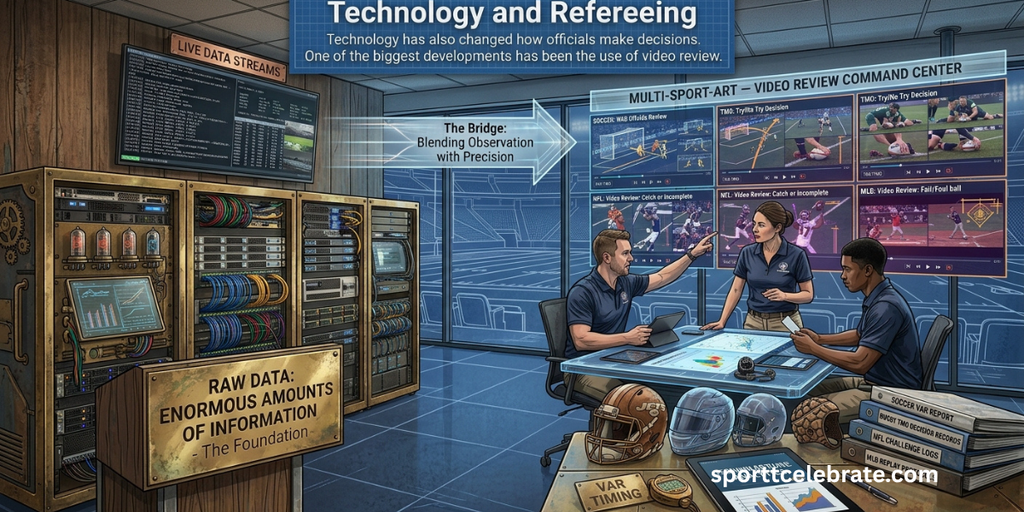
Technology has also changed how officials make decisions. One of the biggest developments has been the use of video review.
In football, VAR allows officials to review certain incidents involving goals, penalties, red cards, and mistaken identity.
Other sports use their own review systems. Tennis has electronic line-calling technology. Cricket uses tools such as ball-tracking and video review.
Basketball officials can review particular plays under established rules. The purpose is generally to reduce major errors.
But technology has also created debate. Some fans appreciate greater accuracy, while others believe excessive reviews interrupt the natural flow of competition.
Must read about: EA FC 26 Top Toxic Celebrations: Competitive Power Guide (2026)
Electronic Timing
In sports where tiny margins determine victory, timing technology is essential. A human stopwatch isn’t precise enough for elite competition.
Modern electronic systems can measure performances to extremely small fractions of a second. This is particularly important in:
- Athletics
- Swimming
- Cycling
- Speed skating
- Motorsport
- Skiing
When competitors finish almost simultaneously, accurate timing can determine who receives the medal. In these situations, technology doesn’t replace competition. It makes the result measurable.
Smart Equipment
Equipment itself has become increasingly sophisticated. Modern sports gear can be designed using advanced materials, computer modelling, and extensive testing.
Examples include:
- Aerodynamic bicycles
- High-performance running shoes
- Smart golf clubs
- Advanced racing helmets
- High-tech swimsuits
- Specialized protective equipment
- Sensor-equipped training tools
The challenge for governing bodies is maintaining fairness. If equipment becomes too influential, wealthy teams or athletes may gain an advantage unrelated to sporting skill. That is why many sports organizations establish detailed equipment regulations.
Technology and Athlete Safety

One of the most valuable uses of innovation is improving athlete safety. Protective equipment has developed significantly across many sports.
Sensors can also help researchers understand impacts, movement patterns, and workload. In contact sports, technology can assist medical teams in assessing incidents.
In other sports, monitoring workload may help coaches identify when athletes need additional recovery. Technology can’t eliminate injuries.
However, it can provide information that supports better decisions about training and competition.
Recovery Technology
Performance isn’t only about what happens during training. Recovery is equally important. Modern athletes may use technology to monitor sleep, training load, heart rate, and other recovery-related information.
Teams can combine these measurements with observations from coaches and medical staff. This can help create more individualized training schedules.
Instead of every athlete following exactly the same programme, teams can increasingly adjust workloads according to individual circumstances.
Virtual Reality Training
Virtual reality in sports offers another interesting development. VR can recreate situations without requiring an athlete to be physically present at a competition venue.
A quarterback, goalkeeper, driver, or other athlete may use simulated environments to practice decision-making. The biggest advantage is repetition.
An athlete can experience similar scenarios multiple times without the physical demands of a full training session. VR isn’t a replacement for real competition, but it can complement traditional practice.
Technology in Motorsport
Motorsport provides one of the clearest examples of technology influencing competition. Racing teams collect enormous amounts of information from cars.
Engineers can monitor temperatures, tire behavior, fuel consumption, aerodynamic performance, and many other variables.
Drivers receive information through sophisticated systems while teams analyze data from the garage.
A tiny setup change can influence performance. Strategy can also depend on technology. Teams use data to decide when to pit, which tires to use, and how to respond to changing race conditions.
Technology in Football and Soccer
Football has adopted several forms of modern technology. Goal-line technology can determine whether the ball completely crossed the line.
Video review can assist referees with certain major decisions. Player-tracking systems can provide information about movement and positioning.
Clubs also use data analysis for scouting and tactical preparation.
This has changed football without eliminating the importance of traditional coaching. A manager still needs to understand players, tactics, psychology, and match situations. Technology simply provides another layer of information.
Technology in Tennis
Tennis has also embraced innovation. Electronic line-calling systems can determine whether shots land inside or outside the court boundaries.
High-speed cameras can track ball movement and player positioning. Performance data can show serve speed, placement, rally patterns, and shot selection.
A player and coach can use this information to identify patterns that might not be obvious during a match.
For example, an opponent may consistently struggle when forced to move into a particular area of the court. Data can help identify that weakness.
How Fans Experience Sports Differently
Technology hasn’t only changed athletes and officials.
It has transformed the sports fan experience.
Fans can now access:
- Live statistics
- Player tracking
- Interactive graphics
- Multiple camera angles
- Instant replays
- Fantasy sports data
- Real-time alerts
- Streaming services
- Social media updates
A television viewer can sometimes see information that wasn’t available to spectators inside the stadium.
This makes watching sports more interactive. Fans aren’t simply watching the action. They’re analyzing it.
The Rise of Sports Streaming

Digital platforms have changed how people consume live competition. Fans no longer have to rely entirely on traditional television schedules.
This has helped international sports reach audiences that may previously have had limited access.
However, it has also created a fragmented viewing environment where different competitions may require different subscriptions.
Technology and Sports Broadcasting
Broadcasting has become more sophisticated as well. Modern productions can combine live video with advanced graphics, player statistics, tactical diagrams, and virtual overlays.
Some broadcasts can show an athlete’s speed, distance, or position almost instantly. Replay systems allow broadcasters to explain controversial moments in detail. This can make complex sports easier for new viewers to understand.
The Problem of Technology Overload
More technology isn’t automatically better. Too much information can overwhelm athletes, coaches, officials, and fans.
A coaching staff might collect hundreds of metrics but only a small number may actually improve performance. The same principle applies to broadcasting.
Constant graphics, statistics, and replay interruptions can distract from the competition itself.
The best systems are usually the ones that provide useful information without making the sport unnecessarily complicated.
Fairness and the Technology Gap

One of the biggest questions surrounding innovation in sports is fairness. Advanced technology can be expensive.
A wealthy professional organization may have access to specialists, laboratories, sensors, software, and data scientists that smaller teams cannot afford. This can create a technological gap.
Sports organizations therefore face an important challenge: allowing innovation while preventing technology from becoming an unfair substitute for sporting ability.
Equipment regulations and standardized competition rules can help address this issue.
Can Technology Replace Human Judgment?
Technology can measure, calculate, and identify patterns.
But sport still depends heavily on people.
A coach understands an athlete’s personality.
A referee interprets the context of a situation.
A player decides when to take a risk.
A team leader motivates teammates when the pressure becomes intense.
These human qualities cannot always be reduced to numbers.
The most effective approach is often a partnership between technology and human expertise.
The Future of Sports Technology
The next stage of innovation will likely involve even more sophisticated data analysis, artificial intelligence, connected equipment, immersive training, and real-time performance monitoring.
Wearable technology may become smaller and more powerful.
AI systems may help coaches identify tactical patterns more quickly.
Virtual and augmented reality could create more realistic training environments.
Fans may also receive increasingly personalized viewing experiences.
But governing bodies will need to keep pace.
They will have to decide which technologies improve sport and which ones fundamentally change the nature of competition.
Why Innovation Matters
The biggest value of sports innovation isn’t simply making athletes faster. Technology can improve accuracy, safety, preparation, communication, accessibility, and entertainment.
A runner can receive more precise timing.
A referee can review a difficult decision.
A coach can understand workload.
A fan can watch a live event from thousands of miles away.
These developments show how technology has become part of almost every level of modern competition.
Final Thoughts
Sports technology has transformed competition from the training ground to the stadium. Wearables provide performance data. Video analysis reveals tactical details. Artificial intelligence can identify patterns.
Electronic timing improves accuracy. Review systems support officials. Advanced equipment can improve performance, while digital platforms have completely changed how fans watch sports.
Yet technology doesn’t make competition meaningful on its own. The athlete still has to perform. The coach still has to make decisions. The official still has to apply the rules. And the fan still cares about the drama of winning and losing.
The future of sport will therefore probably not be about choosing between humans and technology. It will be about finding the right balance between the two.
When used responsibly, innovation can make competition safer, smarter, fairer, and more engaging without taking away the human qualities that make sport worth watching.
FAQs
What is sports technology?
Sports technology includes tools and systems used to improve athletic performance, training, officiating, safety, and fan experiences.
How does AI help sports?
AI can analyze large amounts of data, identify patterns, support scouting, and provide performance insights.
How does technology improve sports officiating?
Video review, electronic timing, tracking systems, and other tools can help officials make more accurate decisions.
Why are wearables useful for athletes?
Wearable devices can track information such as speed, distance, movement, workload, and heart rate.
Will technology replace athletes or coaches?
No. Technology provides information and assistance, but human skill, judgment, strategy, and decision-making remain central to competition.

Will Smith, founder of SportCelebrate.com, shares the best sports gear and celebration finds to fuel your passion and joy.